Annotated Bibliography
Han, M.J., Ryu, J.-E., & Schulz, A. (2024). Research on adolescents’ new media literacy and its cultivation. The Young Thinker’s Review, 2024(5), 14-20. https://doi.org/10.62852/ytr/2024/98
Han et al. (2024) examine how adolescents’ media literacy is being re-conceived in the current digital environment. They argue that “new media literacy” must go beyond traditional notions (e.g., reading a newspaper) and include skills focused on emerging platforms, networked communication, and participatory media. The study emphasizes how teens need to build capacities to respond to evolving digital contexts, and suggests educational strategies for cultivating these literacies.
This article fits my research because it addresses how youth acquire media literacy in the sense of what kind of literacy they need now. It helps move from the “what is media literacy” question into the “how do young people develop it” question (even though you said you’re not limiting to “how young people acquire it” this still helps map the terrain).
I will use this source to clarify how media literacy is changing in the digital age and to support a section of my paper discussing “new media literacy” (vs. older models). Specifically, I plan to quote its definition of new media literacy and use its suggested educational strategies as examples of how literacy can be fostered.
Katapally, T. R. (2024). Navigating the digital world: Development of an evidence-based digital literacy program and assessment tool for youth. Smart Learning Environments, 11, Article 8. https://doi.org/10.1186/s40561-024-00293-x
Katapally (2024) presents the development and validation of a digital literacy program and corresponding assessment tool designed for youth. The paper describes methodology, implementation, and findings that show improvements in digital literacy competencies among participants. It also discusses measurement issues and gaps in existing literacy education.
This source connects with my project because it provides empirical evidence of media/digital literacy programming aimed at youth, including how literacy is operationalised and assessed. So it aids the “what works” part of the discussion (not just definitions).
I plan to use this article in my research to support a section on “interventions/education” in media literacy: showing that programs exist, they can be evaluated, and pointing out the assessment tools used. I’ll draw on the parts about what competencies improved and how they were measured.
Pérez-Escoda, A., Barrios-Rubio, A., Pedrero-Esteban, L. M., & Ávalos, C. (2024). Taking on social media as new gatekeepers among young people: A call upon digital literacy. Information, 15(4), 180. https://doi.org/10.3390/info15040180
Pérez-Escoda et al. (2024) explore the role of social media platforms as “new gatekeepers” of information for young people, and argue that digital literacy must equip youth to understand, critique, and participate in these environments. They emphasise that simply teaching technical skills is insufficient; rather, there must be a critical lens on how platforms mediate information.
This article is highly relevant because it connects media/digital literacy with the realities of youth using social media as primary information sources. It helps me address the dimension of platform-based literacy (how media literacy must adapt when the “media” is social platforms).
I will use this source in my discussion about challenges of media literacy today specifically, to illustrate how social media changes the context and thus what literacy needs to include. I’ll use its distinction between technical and critical dimensions, and cite it when I talk about how youth might need to question platform algorithms and gatekeeping.
Polanco-Levicán, K., & Salvo-Garrido, S. (2022). Understanding Social Media Literacy: A Systematic Review of the Concept and Its Competences. International journal of environmental research and public health, 19(14), 8807. https://doi.org/10.3390/ijerph19148807
Polanco-Levicán and Salvo-Garrido (2022) explore the meaning of social media literacy by reviewing studies from 2010–2021 to identify how researchers define it and what skills it includes. They found that social media literacy involves three main sets of skills: cognitive (critical thinking and evaluating credibility), technical (using and managing social media safely), and socioemotional (understanding behavior, empathy, and communication online). The authors argue that social media literacy extends traditional media literacy and is increasingly necessary in an age of misinformation, but they also note that more research is needed to test how these skills actually influence people’s online behavior.
This article connects closely to my topic about social media literacy and misinformation because it provides a clear definition and framework that I can use to explain what being “social media literate” means.
I plan to use this source to define key terms in my paper and to support my argument that social media literacy must include both critical thinking and emotional awareness to effectively combat misinformation online.
Ziapour, A., Malekzadeh, R., Darabi, F., Yıldırım, M., Montazeri, N., Kianipour, N., & Nejhaddadgar, N. (2024). The role of social media literacy in infodemic management: a systematic review. Frontiers in digital health, 6, 1277499. https://doi.org/10.3389/fdgth.2024.1277499
Ziapour et al. (2024) examine how social media literacy has been used to address misinformation during public health crises, such as the COVID-19 pandemic. Through a systematic review, they identify three main roles of social media literacy in infodemic management: prevention (helping people detect false information before sharing it), correction (encouraging fact-checking and countering false claims), and resilience (building long-term awareness and skepticism toward misinformation). The authors emphasize that while many programs promote social media literacy, few studies measure how effective these interventions actually are, and they call for more research that considers cultural and platform differences.
This article aligns with my topic because it connects social media literacy directly to misinformation control during real-world events.
I plan to use this source to show how social media literacy can be a key strategy for managing misinformation, and to support my argument that improving these skills can help people make more informed choices online and during public crises.
Artifacts
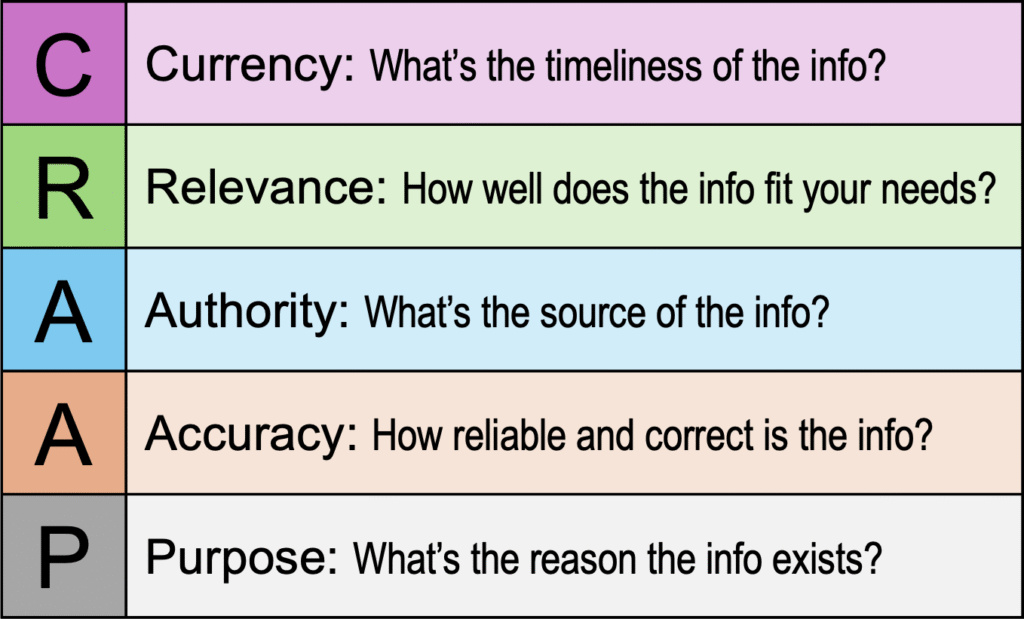
The CRAAP test helped me evaluate each source’s credibility before including it in my annotated bibliography. It allowed me to explain why a source was reliable, relevant, and useful for my research instead of just summarizing it.
Peer review helped me improve my annotated bibliography by showing me where my summaries were too vague or incomplete. My peers specifically suggested that I explain the author’s main argument more clearly and better describe how each source would be useful for my research.
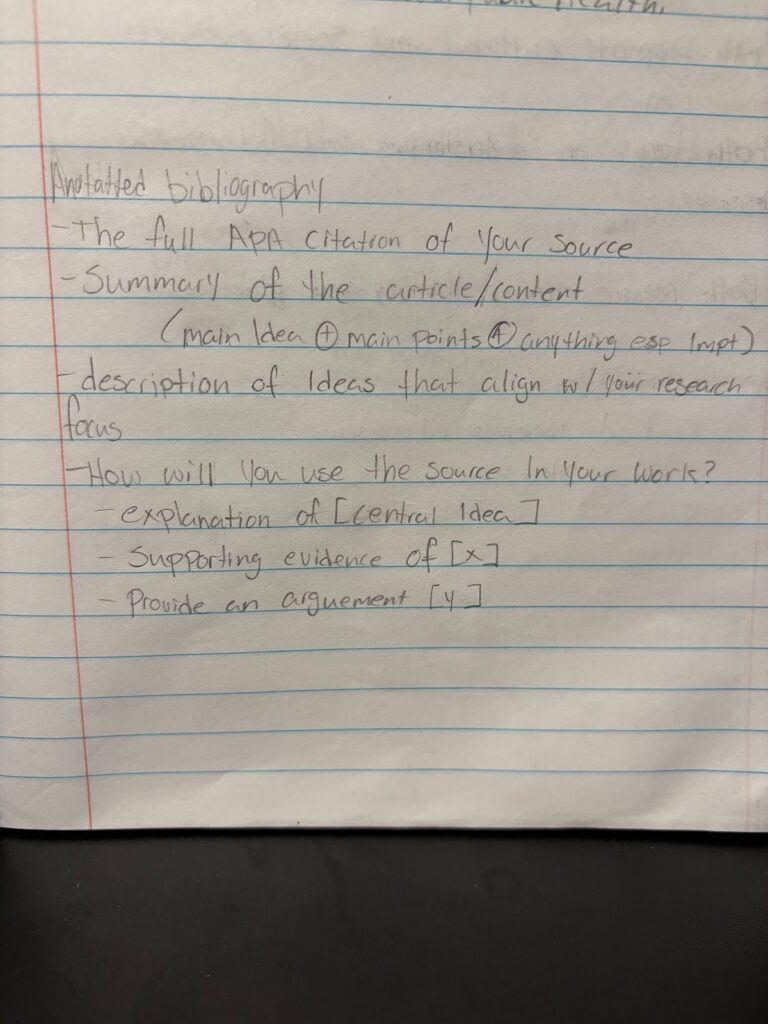
My class notes helped me understand what to include in each annotation, such as the author’s main argument, credibility, and relevance to my topic. They guided me in writing clear, focused annotations instead of just summarizing the sources.
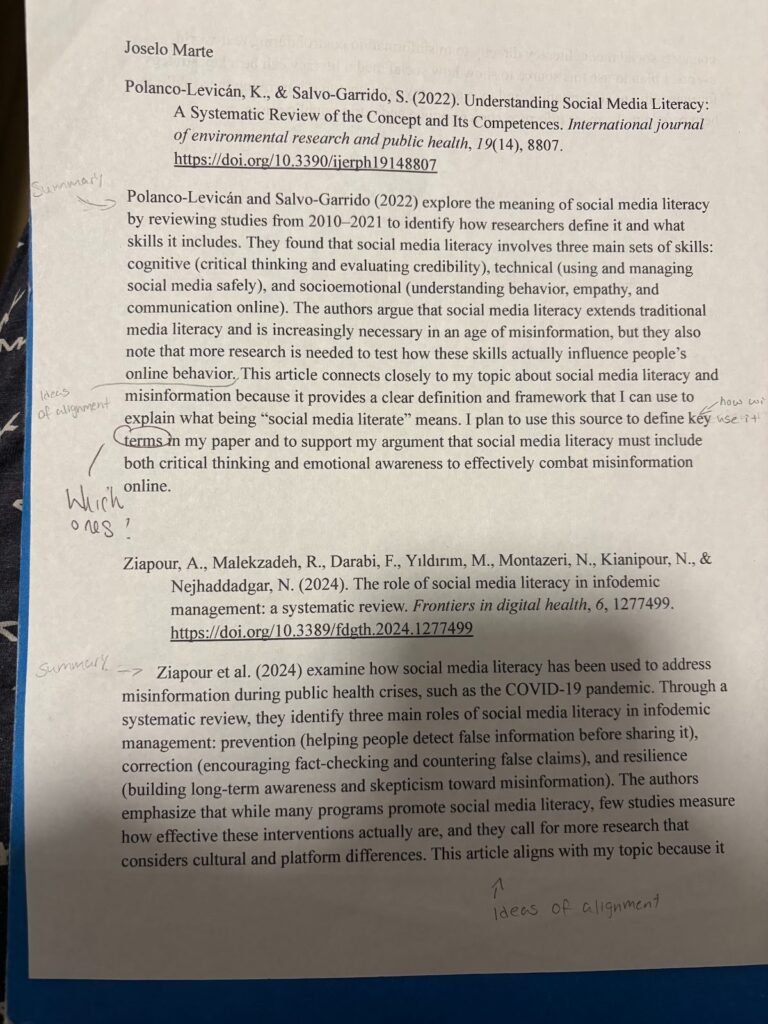
Writing a first draft of my annotated bibliography helped me organize my summaries and evaluate each source before revising. It allowed me to identify what needed clearer explanation, such as the source’s argument, credibility, and usefulness to my research.
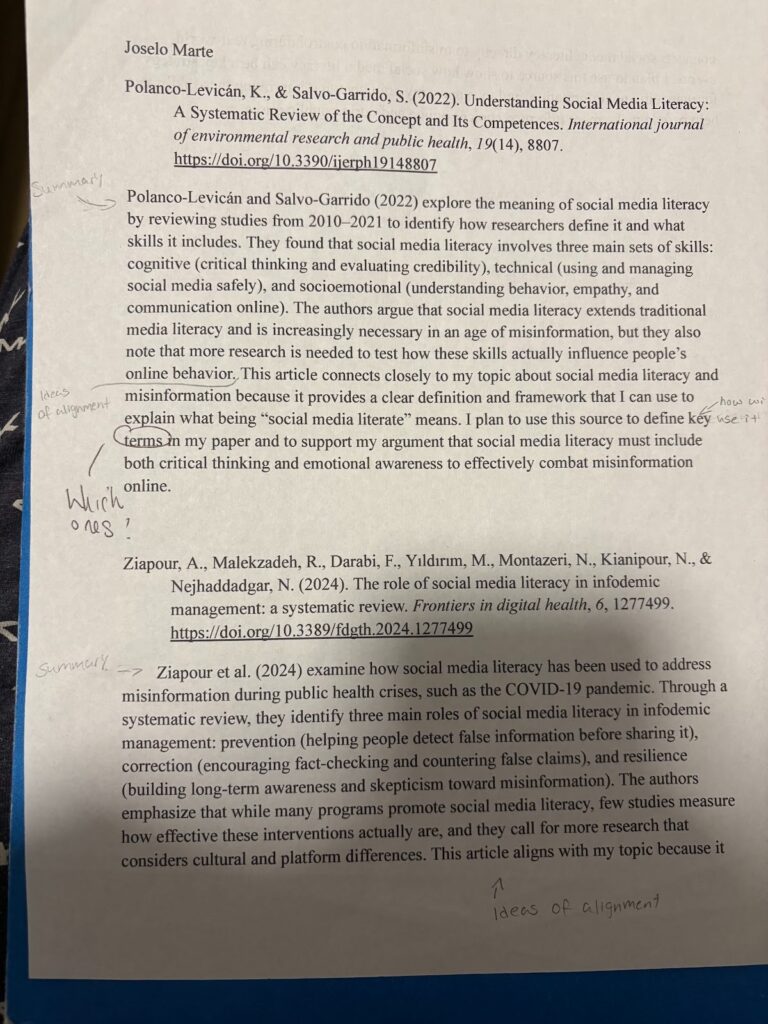
Instructor feedback helped me improve my annotated bibliography by showing me where my annotations needed more detail and clearer evaluation. The comments guided me to better explain each source’s credibility, main argument, and relevance to my research.

This entry is licensed under a Creative Commons Attribution-NonCommercial-ShareAlike 4.0 International license.

